GDPR Compliance Is Not Just Legal — It’s Strategic
February 13, 2026Ransomware is no longer a threat reserved for large corporations.
Ransomware is no longer a threat limited to large corporations.
Today, small and mid-sized businesses — especially those handling sensitive client data — are among the primary targets.
Law firms, insurance brokers, financial advisors, healthcare providers and consultants share one critical vulnerability:
They store valuable data.
And ransomware criminals know it.
What Is Ransomware and Why Is It So Dangerous?
Ransomware is malicious software that encrypts files and systems, making them completely inaccessible.
Once encryption is complete, attackers demand a ransom — usually in cryptocurrency — in exchange for a decryption key.
The problem?
There is no guarantee you will ever recover your data.
- Some companies pay six-figure sums and receive nothing
- Others receive corrupted recovery keys
- Some are attacked again weeks later
Paying the ransom is a gamble — not a recovery strategy.
The False Sense of Security: “We Have a Firewall”
Many organizations believe they are protected because they have:
- A firewall
- Antivirus software
- Endpoint protection
- Network segmentation
- Local server backups
But ransomware rarely breaks through infrastructure defenses.
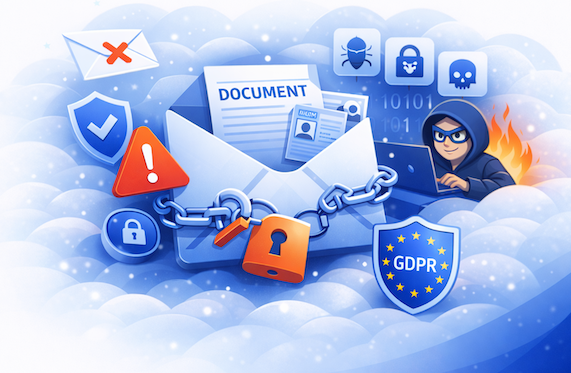
It usually enters through a single phishing click.
- A fake invoice
- A delivery notification
- A message appearing to come from a trusted client
One click is enough.
From that moment, the malware spreads silently across the network.
When it activates, everything is encrypted.
The Real Risk: Client Data on Local Servers and Devices
Businesses storing sensitive information on:
- On-premise servers
- NAS systems
- External hard drives
- Shared network folders
- Employee laptops
Are particularly exposed to ransomware attacks.
When infection occurs:
- Main servers are encrypted
- Network drives are encrypted
- Connected USB backups are encrypted
- Mapped drives are encrypted
Many ransomware variants specifically search for backup files first.
The Backup Illusion: Why External HDD Backups Often Fail
A common assumption:
“We are safe because we have daily backups on an external hard drive.”
If the backup device is connected at the time of infection, it is encrypted too.
Ransomware does not distinguish between primary storage and backup storage.
If it is accessible, it is compromised.
Many companies discover this only after attempting recovery — and finding nothing usable.
Cloud Sync Is Not the Same as Backup
Another misconception is that cloud storage with automatic synchronization provides protection.
If encrypted files sync automatically to the cloud:
- Local data becomes encrypted
- Cloud copies replicate the encrypted versions
- Version history may be limited
- Recovery windows may be short
Without immutable storage or ransomware detection mechanisms, damage spreads everywhere.
Generic cloud sync alone is not a true ransomware recovery strategy.
The Financial and Legal Impact of a Ransomware Breach
For organizations handling personal data, consequences may include:
- Permanent loss of client contracts
- Exposure of sensitive personal information
- Operational shutdown
- Regulatory investigations
- Mandatory breach notifications
- Loss of trust
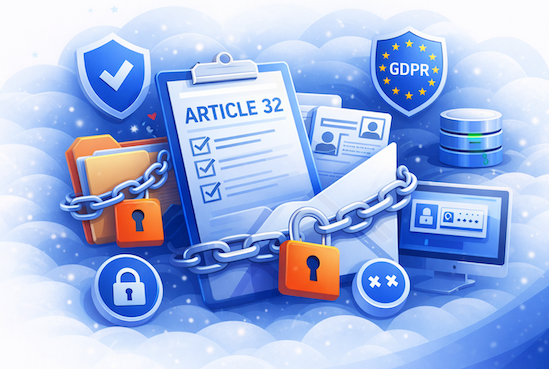
Under GDPR Article 32, companies must implement appropriate technical measures to protect personal data.
Failure to do so may lead to:
- Fines up to €20 million or 4% of annual turnover
- Mandatory disclosure to affected clients
- Severe reputational damage
In many cases, reputational damage exceeds financial loss.
Paying the Ransom: A Risky Decision
When systems are locked and operations stop, panic drives decision-making.
Ransom demands may range from:
- €10,000
- €50,000
- €250,000
- Or significantly more
However:
- Decryption keys often fail
- Attackers sometimes disappear
- Repeat extortion is common
Even after recovery, systems may remain vulnerable.
The Real Question: How Many Clicks Away Are You?
Your security is not defined by your firewall.
It is defined by the weakest human action inside your organization.
- One phishing email
- One distracted employee
- One malicious attachment
Years of client data can disappear in minutes.
What Businesses Must Rethink
Effective ransomware protection requires:
- Zero-trust access principles
- Encrypted document exchange
- Controlled file-sharing environments
- Immutable and isolated backups
- Ransomware-resistant architectures
- Strict permission segmentation
- Continuous monitoring
Sensitive client data should not be freely accessible across shared networks or uncontrolled synchronization systems.
Data protection must be designed by architecture — not by hope.
Conclusion: Ransomware Is a Business Survival Issue
Every organization handling client data must ask:
If tomorrow everything is encrypted, can we survive?
If the answer is uncertain, the risk is real.
Ransomware attacks are increasing, becoming more automated and more targeted.
The difference between businesses that survive and those that collapse is simple:
Preparation.
Because once encryption begins, recovery options are limited.