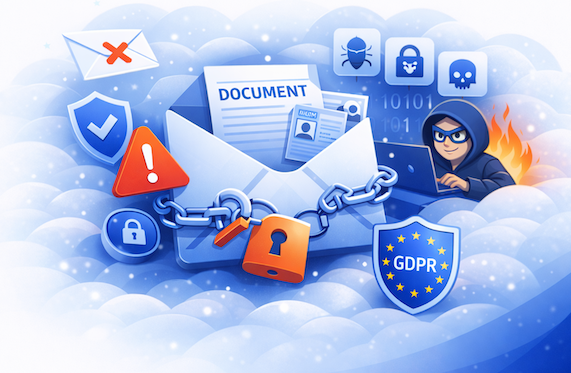
Why Email Is Not GDPR-Compliant for Sending Sensitive Client Documents
February 13, 2026
Ransomware Attacks on Businesses, Why Local Servers, Cloud Sync and Backups Are Not Enough
February 13, 2026GDPR Article 32 Explained: Encryption, Access Control and the Legal Duty to Protect Client Data
Many businesses believe GDPR compliance is primarily about privacy policies and cookie banners.
It is not.
At the core of the General Data Protection Regulation lies a far stricter obligation: protecting personal data through appropriate technical and organizational measures.
This legal duty is clearly defined in Article 32 of the GDPR — and it applies to any organization that stores, processes or transfers personal data.
Failure to comply can result in fines of up to:
- €20 million
- Or 4% of global annual turnover
Whichever amount is higher.
What Does GDPR Article 32 Actually Require?
Article 32 focuses on the security of processing.
It requires data controllers and processors to implement technical and organizational measures appropriate to the level of risk.
These measures include, where relevant:
- Encryption of personal data
- Ensuring ongoing confidentiality
- Maintaining integrity and availability of systems
- Implementing effective access control mechanisms
- Restoring availability after incidents
- Regular testing and evaluation of security measures
This is not a recommendation.
It is a legal obligation.
Encryption Is a Legal Requirement — Not an Optional Feature
Article 32 explicitly mentions encryption as a core security measure.
Yet in practice, many organizations still:
- Store client documents unencrypted on local devices
- Use shared folders without strict permissions
- Maintain on-premise servers without encryption at rest
- Transfer sensitive documents via standard email
- Rely on generic cloud storage services without end-to-end encryption
Often there is:
- No end-to-end encryption
- No granular role-based access control
- No monitoring of document access
- No logging of file activity
From a regulatory standpoint, this creates substantial exposure.
The Risk of Local Storage and On-Premise Infrastructure
A common scenario involves client data stored on:
- Local office servers
- Employee laptops
- NAS devices
- External drives
There may be a firewall. There may be antivirus software.
But frequently there is no:
- Encryption at rest
- Role-based access management
- Zero-trust architecture
- Comprehensive audit trail
- Segregation of sensitive data
If a device is stolen or infected with ransomware, personal data may be fully exposed.
Under GDPR, responsibility remains with the organization.
Data Transfers Fall Under Article 32
GDPR Article 32 applies not only to storage, but also to data transfers.
Sending contracts, identification documents or financial records through:
- Standard email
- Messaging applications
- Uncontrolled cloud links
- Unencrypted file-sharing services
May result in regulatory consequences if intercepted.
In the event of a breach, organizations may be required to:
- Notify supervisory authorities
- Inform affected data subjects
- Document the incident
- Demonstrate implemented safeguards
Without encryption and controlled access, demonstrating compliance becomes extremely difficult.
“We’ve Never Had a Breach” Is Not a Valid Defense
GDPR compliance is proactive.
Supervisory authorities assess whether:
- Encryption was properly implemented
- Access control matched the data sensitivity
- Security measures were risk-based
- Risk assessments were documented
If sensitive data was stored unencrypted or shared insecurely, penalties can escalate significantly.
The Financial and Reputational Impact of Non-Compliance
Beyond administrative fines, consequences may include:
- Business interruption
- Mandatory breach notifications
- Client litigation
- Loss of commercial contracts
- Long-term reputational damage
In sectors such as legal, insurance, finance and healthcare, trust is fundamental.
Once lost, it is difficult to restore.
Why Many Businesses Remain Non-Compliant
Despite the clarity of Article 32, many organizations still:
- Store client data on personal desktops
- Use shared office servers without strict access controls
- Depend on basic cloud storage without end-to-end encryption
- Lack documented security policies
- Do not enforce multi-factor authentication
- Do not log access to sensitive files
Often this results from outdated infrastructure and underestimated risk.
However, lack of awareness does not exempt liability.
What GDPR-Compliant Data Protection Should Include
To align with GDPR Article 32, organizations should implement:
- End-to-end encryption for data in transit
- Encryption at rest
- Granular, role-based access control
- Multi-factor authentication
- Comprehensive audit logs
- Secure document-sharing environments
- Isolated and immutable backups
- Continuous risk assessments
Security must be embedded in system architecture — not retrofitted after an incident.
GDPR Compliance Is Strategic, Not Just Legal
Clients expect secure handling of personal information.
Organizations implementing strong encryption and access control reduce regulatory exposure while strengthening competitive positioning.
Data protection is no longer merely a regulatory burden.
It is a strategic advantage.
Final Question: Is Your Infrastructure Ready for Regulatory Scrutiny?
If client data is stored:
- On local machines without encryption
- On shared servers without strict permissions
- In cloud platforms without end-to-end encryption
- Transferred via unsecured channels
Then the risk is significant.
Article 32 is clear: security measures must be proportionate to risk.
When handling sensitive client data, that risk is inherently high.
Protecting Client Data Requires More Than Policies
Modern organizations require secure, encrypted environments designed specifically for confidential document storage and exchange — with built-in access control, traceability and compliance by design.
Because under GDPR, prevention is always less expensive than penalties.